Service

Collect useful industrial data with factory constraints in view

Industrial data integration makes approved equipment and operational information available for reporting and workflows. It is distinct from safety-critical machine control, PLC programming, and control-system engineering.

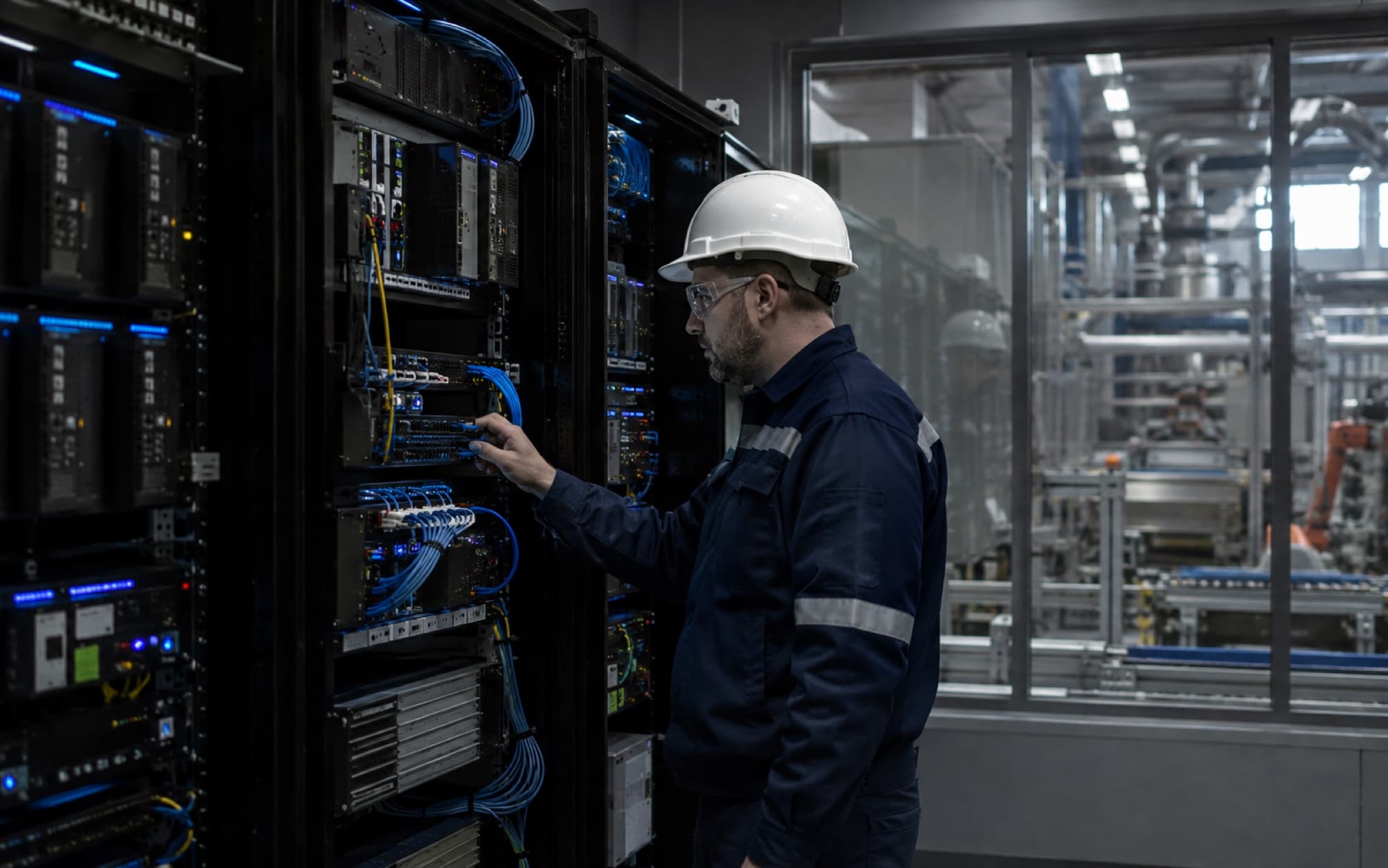
Illustrative modern manufacturing floor with an operations leader observing production equipment
01

Understand

Where this service fits

This work is most useful when operational symptoms are visible but the target workflow, ownership, or system boundary is not yet dependable.

01

Machine records have inconsistent timestamps

02

Connectivity gaps create silent reporting holes

03

Equipment identifiers differ across maintenance and production

04

Analytics requests risk direct unmanaged access to control networks

02

Understand

A proposed before-and-after workflow

Current state

Teams pull ad hoc exports or manually record counters without a documented boundary.

Proposed state

Approved read-only sources publish named signals through a governed gateway, buffer during outages, retain quality flags, and map equipment identifiers to business context.

The future state remains a design until it is tested with the people, data, systems, and exceptions in scope.

03

Deliver

Scope and deliverables

The exact package follows discovery and agreed responsibilities. A typical engagement can include:

01

Source and signal inventory

02

Read-only boundary and network data-flow design

03

Timestamp and identifier standard

04

Buffering, quality, and monitoring rules

05

Data consumer contract and support handover

04

Deliver

Data and decisions needed

Access is limited to what the agreed work needs. Client owners approve source authority, operational rules, and acceptance criteria.

ReferenceInput or decision to establish
01Approved source protocols and vendor documentation
02Network zones and connectivity constraints
03Tag meanings, units, frequency, and tolerances
04Equipment and work-order identifiers
05

Deliver

Delivery sequence

A bounded sequence protects continuity and makes learning visible before wider rollout.

  1. 01
    Define the information use caseDefine evidence and the exception path
  2. 02
    Confirm control-system responsibility boundaryDefine evidence and the exception path
  3. 03
    Inventory and qualify sourcesDefine evidence and the exception path
  4. 04
    Pilot read-only collectionDefine evidence and the exception path
  5. 05
    Test loss, delay, and reconnect behaviorDefine evidence and the exception path
  6. 06
    Operationalize monitoring and ownershipConfirm ownership and handover
06

Govern

How it fits existing systems

Existing systems are mapped by business responsibility, supported interface, data authority, update timing, and failure behavior. The design may integrate, configure, retain, or replace a component; no universal compatibility is assumed.

07

Govern

Measurement, timeline, and cost

Baseline definitions are agreed before implementation. Timeline and cost vary with system access, data quality, process variation, security, testing, number of sites, adoption, and support scope.

01

Expected records received with quality status

02

Timestamp completeness and drift

03

Buffered records recovered after interruption

04

Signals with documented owner, unit, and meaning

08

Govern

When a different approach may be better

When a use case can be met from an existing MES or historian, reuse that governed source instead of adding a new machine-level connection.

Buying questions

Questions to resolve before work starts

These answers establish a practical default. Actual scope follows the systems, process, data, risks, and responsibilities in view.

01Can this work with our existing systems?

Usually, but compatibility must be confirmed. We first identify supported interfaces, data ownership, update frequency, security constraints, and failure behavior. Where a direct connection is unsafe or unavailable, a controlled file exchange or staged replacement may be more appropriate.

02How do you limit disruption during rollout?

We keep the first scope bounded, test with representative data, define rollback and manual fallback procedures, and agree a cutover window with process owners. Safety-critical control remains outside an information-workflow project unless separately assessed by qualified specialists.

03How are scope, timeline, and price determined?

They depend on process variation, systems and interfaces, data condition, security requirements, testing effort, number of sites, training, and support boundaries. Discovery produces an evidence-based scope rather than an unsupported fixed promise.

04How do we know whether the work is worthwhile?

Agree the metric, definition, baseline period, comparison conditions, data source, owner, and review date before changing the workflow. Released capacity is reported separately from cash savings, and operational outcomes are not attributed to software without comparable evidence.

05What happens when an automated step fails?

The design should make failures visible, retain the source record, route the item to an owned exception queue, allow authorized correction, and preserve an audit history. A workflow is incomplete until its exception path is tested.

01

Start with one process

Which workflow currently costs your team the most time?

Bring one normal example and one exception. Use them to frame the systems, decisions, controls, and evidence a sensible next step needs.

Discuss your operation